Dynavector DV505 Tone arm Instruction Manual
INDEX
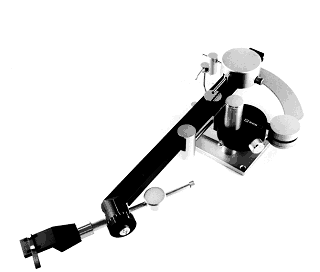
Dynavector DV-505 tone arm has an entirely new concept in tone arm design. The DV-505 is a high performance tone arm with various new functions that make the cartridge in use work the best way it can. The DV-505 user is requested to please read through this brochure to enjoy its niceties fully.
- 1. Foreword
- 2. Parts illustration
- 3. Pre use check points
- 4. Application(1)
- 5. Application(2)
- 6. Arm resonance
- 7. Two dampers
- 8. Specifications
1. Foreword
As is commonly known, a pickup cartridge generates electricity by cantilever motion relative to motion of cartridge proper. While cantilever stylus precisely traces signals recorded in groove of disk, cartridge proper receives those signals faithfully provided that it is held motionless (free of vibration). Hence, the great role of a tone arm.
How should cartridge be held motionless without adverse effects on signal trackability? The DV-505 has solved this problem by adopting the unique (vertical/horizontal) Bi-axis system. The horizontally movable main arm is of sufficient weight for vibration-free operation, and the adverse effect of weight on signal trackability is nullified by use of an angular-radial compound bearing design. Conversely, the vertically movable sub-arm is made so light that it never lets the stylus jump the groove of even a disk with warp(s) previously unnegotiable.
Also, the DV-505 employs a double damper method -- inertia controlled dynamic damping type plus electro-magnetic damping type -- to introduce an ideal solution to the problem of tone arm resonance in low frequency range. This has generally been neglected about audio equipment that absolutely requires a flat frequency characteristic.
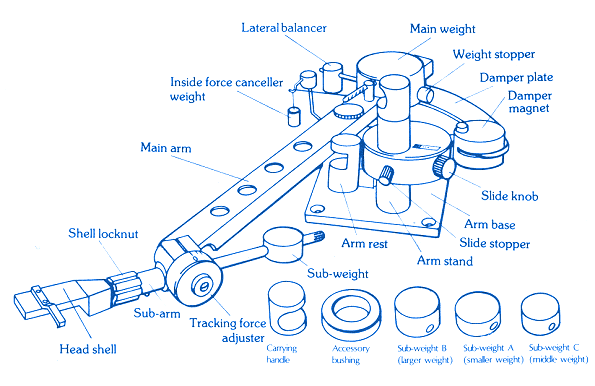
2. Parts illustration
3. Pre use check points
The DV-505 leaves factory only after fine adjustment and meticulous check. But unexpectable incidents in transit can possibly change its condition.
To use the DV-505 in its best condition, the user is requested to check the following points prior to application:
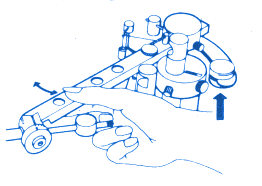
Isn't damper plate in contact with magnet?
Pick up main arm and gently reciprocate it sideways. If damper plate is free from bent (or distortion) and clear of magnet, main arm can be thus moved smoothly. Otherwise, metallic frictional sound occurs and, as this motion is forced, it encounters growing resistance. In such a case, confirm direction in which damper plate is bent and apply finger pressure to put it into right and straight shape. (This copper plate can be deformed with ease. After its adjustment, it must not be touched by hand or hit by foreign object.)
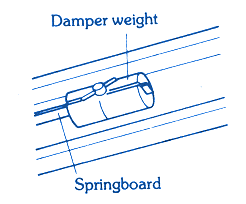
Is inertia controlled dynamic damper functioning?
Pick up main arm gently and look in from below. Normally, damper weight is seen vibrating finely. If it is in contact with arm's inner surface and is not so vibrating, Loosen stopper and, with light downward pull, refasten it, and/or straighten springboard.
4. Application (1)
Output cord fixing
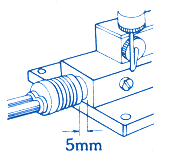
As illustrated connect output cord connector (accessory attachment) securely to output terminal plug below arm. Even when this is complete, connector leaves plug stem uncovered for 5mm, which is so designed to be compatible also with other output cords sold generally on the market.
Headshell/cartridge fixing
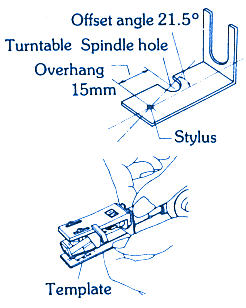
Fix cartridge to shell (for temporary purpose), insert template between arm and shell, and lock shell. Then where stylus points exactly at special mark on template, fix cartridge securely to shell.
Do not remove template yet because it will also be used, the way it is, for positioning arm.
(Stylus position so determined allows for template thickness. When template is removed and shell finally locked completely, stylus finds itself in right position.)
Base fixing to player board
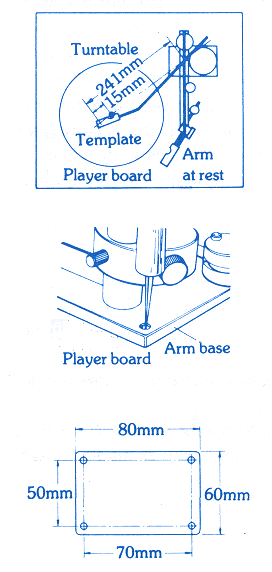
The DV-505 can be fixed to player board simply by nailing its unit base plate with four wood screws provided to each unit.
Relax slide stopper and turn slide knob to lift main arm to a height where cartridge stylus won't scratch turntable. Then move arm base to where turntable spindle smoothly fits in with spindle hole in template.
When spindle and hole so fit, and at the same time main arm is situated right above arm rest, part of base plate not overshadowed (overlapped) by turntable (see illustration) is available for screw drive-through.
Base position so determined, drill convenient screw holes in player board and fix base plate onto it with wood screws (supplied).
* In case that player board has not insulator, or if the user wants to set the DV-505 without fixing to player board. Put the rubber sheet (supplied) under the base plate. (At usual conditions of use, this is not necessary.)
Arm height adjusting
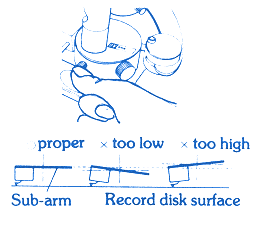
With slide stopper relaxed, height of arm can be adjusted by turning slide knob. But as arm slowly sinks by itself when slide stopper is loosened, an easy way to adjust arm height is, first lift arm to maximum height, then let arm sink while holding stopper between fingers, and finally fasten stopper just when arm comes down to right place.
Arm must be just so high that sub arm may precisely parallel record disk surface.
Arm balancing
Horizontal balancing
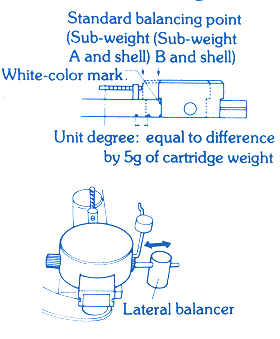
Main arm is designed to maintain itself always level. But horizontal balancing is still necessary to distribute bearing load evenly and thereby realize best trackability. To achieve this balance, shell and sub weight alone normally suffice. First position sub weight A closest to the fore, or sub weight B at white-color balancing point mark, and then slide sub weight on scaled bar by one notch backward per every 5g added to cartridge weight. (In using any shell other than one supplied, add to or deduct from cartridge weight the difference in weight between these two shells.)
Lateral balancing
If arm flows laterally to either side while inside force canceller weight is suspended from zero point or is removed from cartridge, slide lateral balancer to either side to prevent arm from flowing so. (Make sure beforehand that arm base is set level.)
Tracking force adjusting
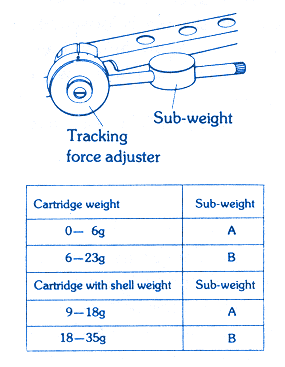
First set tracking force adjuster to zero point and balance sub arm precisely level by sliding sub-weight to right position. Sub arm so balanced, turn adjuster finger screw to obtain necessary tracking force. Adjuster scale is graduated by 0.25g and between graduation marks, too, adjustment is done progressively in proportion to adjuster screw advance.
Choose sub weight A or B according to guide table to the left. Protruding in hole in sub weight is a pin to stop sub weight from pivoting on scaled bar. Mount sub-weight onto bar with this pin pressed with screwdriver, etc.
Inside force canceller
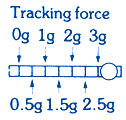
To suspend inside force canceller weight from weight scale bar, do it exactly from graduation mark equal to tracking force selected.
When the DV-505 tone arm is moved up (and down) before and after record playing, main arm as a whole is designed to be elevated. But user is requested not to lift it excessively or with abrupt force.
5. Application (2)
Player equipped with cover
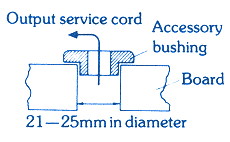
Player may have its cover. Because the DV-505 output service cord is not led out through player board, cover won't close neatly.
In such a case, make a hole (21mm - 25mm in diameter) at a convenient place in player board, fit accessory bushing to hole so made, and run output cord through it.
Arm base posture adjusting
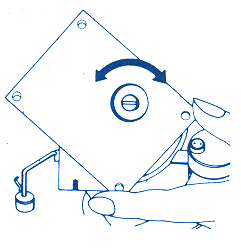
In case that player board fails to provide sufficient space for arm base, loosen screws on backside of base and change direction of arm stand.
To carry DV-505 around
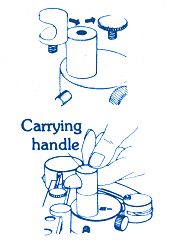
Stand top cover is screwed into stand. Replace it with accessory carrying handle.
The DV-505 unit can then be carried around as illustrated.
To replace output terminal
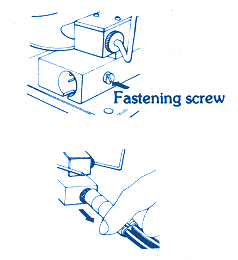
Cord connector can be removed in the following manner, either for replacement with another kind of connector or for complete removal to eliminate needless contact resistance:
red -Right channel hot
white -Left channel hot
green -Right channel ground
blue -Left channel ground
(Fastener screw also serves as unit connection to earth.)
6. Arm resonance in low frequency range
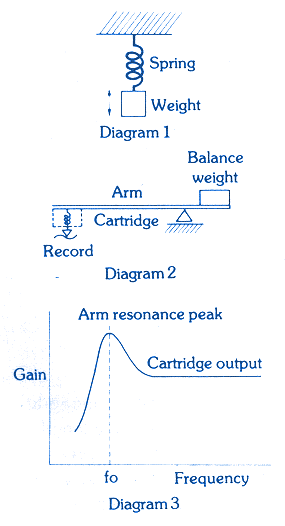
Illustration shows spring in suspension from overhang and weight slung from it. When pulled down and then released, spring weight combination will reciprocate longitudinally at a certain frequency. This is generally called spring mass oscillation system. Oscillation of two units of mass at a common fixed frequency is called resonance. This frequency ('f') Is mathematically expressed
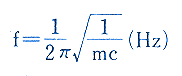
Where 'c' is system compliance in cm/dyne and 'm' stands for mass of system.
Similar phenomenon is observed in arm-cartridge assembly as it reproduces sound from record disk. Graphically, cartridge compliance may be likened to spring, and arm pivot to weight.
This is what is called arm resonance in low frequency area, and there are as many resonance sources as there are pivoting gadgets in tone arm.
At such a frequency of resonance arm becomes very sensitive to vibration and, even when frequencies of 'flat' characteristics are reproduced from record, arm resonance causes larger output than true to record or 'peak' phases (See diagram 3). At frequencies higher than arm resonance, arm does not so vibrate at all, and cantilever oscillation alone translates into output. But at frequencies lower than that, cantilever and arm oscillate together and fail to generate electricity. This is why arm resonance frequency 'fo' is called low sound reproduction margin.
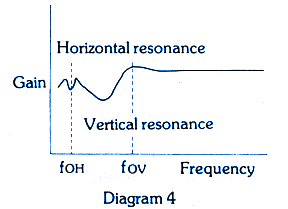
With conventional type tone arms vertical and horizontal pivots are placed in close proximity. This causes these two resonance sources to vibrate at the same frequency, as if vibrating as a unit. Peaks then become larger and so much harder to damp.
The Bi-axis type DV-505 separates one pivot remotely from the other. It thus encounters two peaks simultaneously, but each peak is smaller than the two put together, and horizontal resonance peak is effectively cut by a couple of unique dampers (See diagram 4), for the following reason :
So-called '45-45' record groove cutting method which is presently in use, does horizontal cutting at same phases of input signal and vertical cutting at inverse phases. Because sub-100Hz wave lengths elongate for more than several meters, stereo recording of low sounds produces, almost comprehensively, same phase signals for both right- and left-hand side channels and, naturally, signals for horizontal cutting come excessively to the fore. Then considering disk structure, it Is not possible to impress on it deep-going low frequency signals.
The DV-505 has solved just that. By reducing peaks over all, it adds to low frequency area stability. Also, it faithfully tracks surfaces so warped that no other tone arms could negotiate well, and thereby limits effect of such warped disks on sound reproduction. The DV-505 an out performer.
7. Two dampers
As explained in part 7, DV-505 employs two kinds of damper- - electro magnetic and inertia-controlled type.
electro magnetic damper
This damper applies effect of eddy current, which is generated when conductor moves in magnetic field, and which obstructs conductor in motion. It has almost no damping effect on motion of non-vibrating tone arm, but is highly effective to vibration of arm, such as arm resonance.
Inertia controlled dynamic damper
This damper, incorporated into main arm, consists of a pair of spring and mass, each of these constituents having a carefully selected constant. This spring mass oscillation system oscillates only horizontally as main arm resonance occurs, and causes resonance peak to dip. Phase lag in one oscillation system relative to another is effectively applied in this damper, which functions only in response to arm resonance.
8. Specifications
| System | Bi-axls inertia controlled dynamic balance type tone arm |
| Total length | 335mm (including shell) |
| Effective length | 241mm |
| Overhang | 15mm |
| Offset angle | 21.5 degree |
| Height | 72mm (liftable to max. 94mm) |
| Height adjustability | 37-70mm (at sub arm center) |
| Optimum cartridge weight | 0 - 23g (or up to 35g including headshell) |
| Tracklng force adjustability | 0 - 3g by 0.25g step |
| Lateral tracking angle error | -1.1 degree to +2.2 degree (0 degree at inner band of record disk, 2.2 degree at outside) |
| Motion sensitivity | Lateral -- less than 50 mg Vertical -- less than 50 mg |
| Net weight | 1,250 g |
| Output connector | 5P connector with low resistance cord 0.025 ohms/m, 37pF/m |
| Head connector | EIA standards |
| Head shell | Aluminum headshell |
